Stained Glass Window
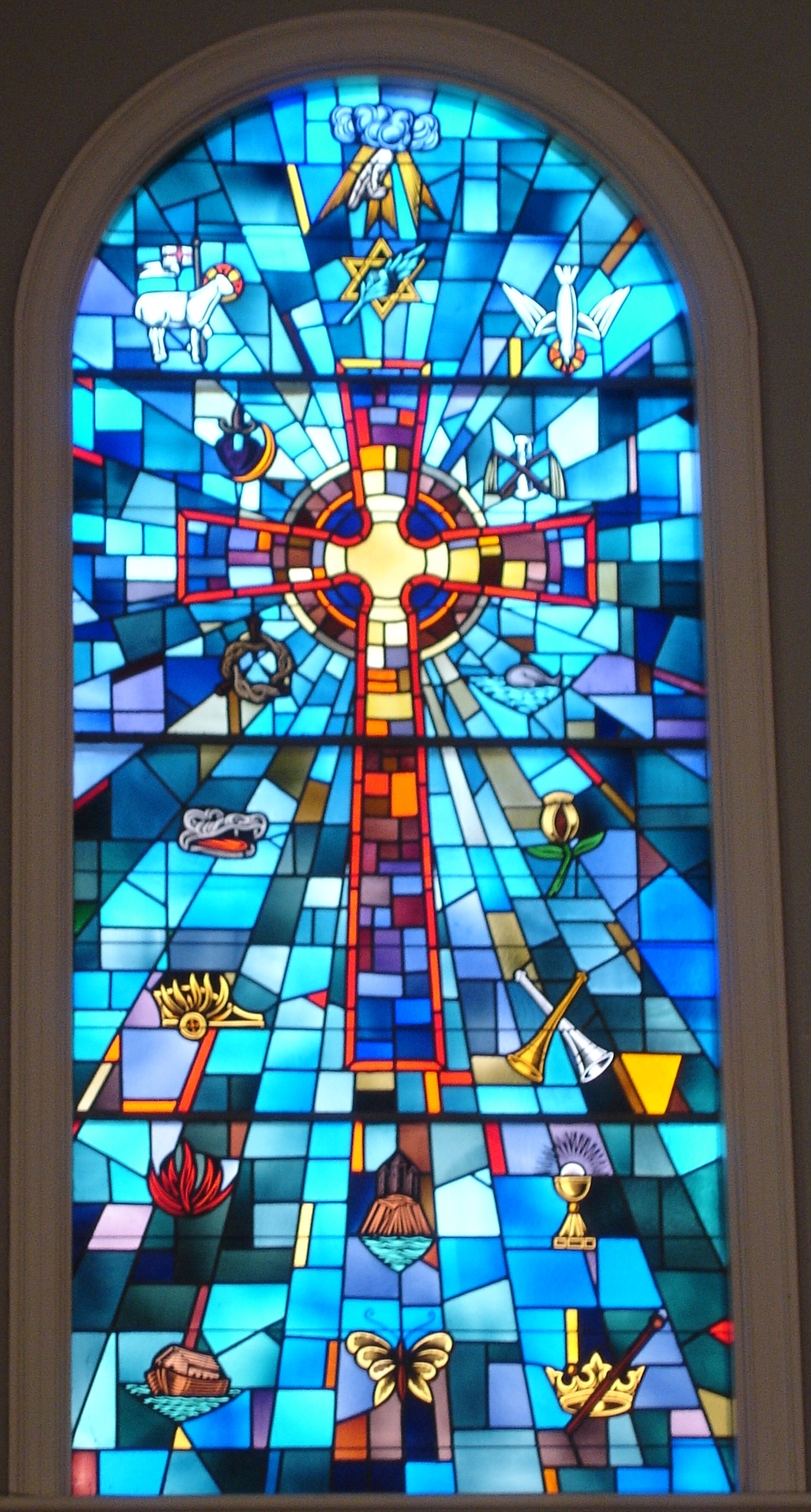
The stained glass window above the altar uses symbols to represent the Christian faith as summarized in the Apostle's Creed. This document explains those symbols and their meaning in relationship to the Creed.
THE SYMBOLS:
 The HAND ISSUING FROM THE CLOUDS symbolizes God the Father.
|
 The 6 POINTED STAR is the star of creation and symbolizes our
triune God (Father, Son, and Holy Spirit. The Palm Branch Symbolizes a
part of God's creation that was later used at Jesus' Triumphal Entry.
(Matthew 21:8)
The 6 POINTED STAR is the star of creation and symbolizes our
triune God (Father, Son, and Holy Spirit. The Palm Branch Symbolizes a
part of God's creation that was later used at Jesus' Triumphal Entry.
(Matthew 21:8)
|
 The LAMB symbolizes the Son of God who came "to save His
people from their sins." (Matthew 1:21) Jesus was the "Lamb of God who
took away the sins of the world." (John 1:29)
The LAMB symbolizes the Son of God who came "to save His
people from their sins." (Matthew 1:21) Jesus was the "Lamb of God who
took away the sins of the world." (John 1:29)
|
 The DOVE symbolizes the Holy Spirit who descended on Jesus at
His baptism in that visual form. (Matthews 3:16)
The DOVE symbolizes the Holy Spirit who descended on Jesus at
His baptism in that visual form. (Matthews 3:16)
|
 The CRESCENT MOON and the PIERCED HEART symbolize the
Virgin Mary. These symbols relate to Mary's pierced heart after
witnessing her Son Jesus' death. (Luke 2:35)
The CRESCENT MOON and the PIERCED HEART symbolize the
Virgin Mary. These symbols relate to Mary's pierced heart after
witnessing her Son Jesus' death. (Luke 2:35)
|
 The PILLAR WITH CROSSING WHIPS symbolize the trial,
condemnation and suffering of Jesus as He was tied to such a pillar in
order to be scourged with lead-tipped whips. (Matthew 27:26)
The PILLAR WITH CROSSING WHIPS symbolize the trial,
condemnation and suffering of Jesus as He was tied to such a pillar in
order to be scourged with lead-tipped whips. (Matthew 27:26)
|
 The CROWN OF THORNS and 3 NAILS (Matthew 27:27-31) symbolize Jesus'
death and victory over sin and death.
The CROWN OF THORNS and 3 NAILS (Matthew 27:27-31) symbolize Jesus'
death and victory over sin and death.
|
 The FISH symbolizes that Jesus died and was buried. It also exhibits
each person's need for a Savior and that salvation only comes through
Jesus Christ.
The FISH symbolizes that Jesus died and was buried. It also exhibits
each person's need for a Savior and that salvation only comes through
Jesus Christ.
|
 The DRAGON'S HEAD symbolizes the devil, sin and hell. (Revelation 12:13)
|
 The golden POMEGRANATE is a symbol of the power of God who overcame
death through Jesus' resurrection from the tomb. It is also a symbol for
royalty and the future life. (Mark 16:1-8)
The golden POMEGRANATE is a symbol of the power of God who overcame
death through Jesus' resurrection from the tomb. It is also a symbol for
royalty and the future life. (Mark 16:1-8)
|
 The FIERY CHARIOT symbolizes the ascent of Jesus into heaven, 40
days after the resurrection, (Acts 1:9) Note also the reference to
Elijah's ascension in (II Kings 2:11).
The FIERY CHARIOT symbolizes the ascent of Jesus into heaven, 40
days after the resurrection, (Acts 1:9) Note also the reference to
Elijah's ascension in (II Kings 2:11).
|
 The CROSSED TRUMPETS are symbolic of Jesus' triumphal reign with the Father,
the Second Coming and the final judgment. (I Thessalonians 4:16)
The CROSSED TRUMPETS are symbolic of Jesus' triumphal reign with the Father,
the Second Coming and the final judgment. (I Thessalonians 4:16)
|
 The SEVEN FLAMES symbolize the Holy Spirit and the fire
associated with the Spirit's coming on the day of Pentecost. The number
7 is God's number of perfection. (Acts 2:1-4)
The SEVEN FLAMES symbolize the Holy Spirit and the fire
associated with the Spirit's coming on the day of Pentecost. The number
7 is God's number of perfection. (Acts 2:1-4)
|
 The CHURCH ON THE ROCK is a reference to Matthew 7:24 wherein
Jesus exhorts His followers to build their spiritual house on the sure
foundation of Jesus Christ and His Word.
The CHURCH ON THE ROCK is a reference to Matthew 7:24 wherein
Jesus exhorts His followers to build their spiritual house on the sure
foundation of Jesus Christ and His Word.
|
 The CHALICE OF GOLD symbolizes the Sacrament of the Lord's Supper
where all Christians gather as the "communion of saints" in worship.
(I Corinthians 11:25-28)
The CHALICE OF GOLD symbolizes the Sacrament of the Lord's Supper
where all Christians gather as the "communion of saints" in worship.
(I Corinthians 11:25-28)
|
 The ARK symbolizes the church who speaks forth the Gospel of Jesus
Christ for the forgiveness of sins for all who would repent, believe and
be baptized. (I Peter 3:18-22)
The ARK symbolizes the church who speaks forth the Gospel of Jesus
Christ for the forgiveness of sins for all who would repent, believe and
be baptized. (I Peter 3:18-22)
|
 The BUTTERFLY symbolizes eternal life with Jesus Christ wherein
believers will dwell with God forever. (Revelation 21:1-7)
The BUTTERFLY symbolizes eternal life with Jesus Christ wherein
believers will dwell with God forever. (Revelation 21:1-7)
|
 The CROWN symbolizes Jesus as our King who will bestow the "Crown of
Righteousness" on all believers who die in Him. (II Timothy 4:7-8)
The CROWN symbolizes Jesus as our King who will bestow the "Crown of
Righteousness" on all believers who die in Him. (II Timothy 4:7-8)
|